Your company pays for Copilot licenses for everyone. There was a launch with all the bells and whistles, a training program, a best-practices guide and even an email from the CEO with the word “transformation” in the subject line, but three months later the usage dashboard is practically flat. Meanwhile, if you look just a little below the desk, you’ll see your team using ChatGPT on their phones every single day.
So, are people resisting AI? Well, not exactly, because they are using it, just where no one can see. And what looks like a contradiction at first has a pretty concrete explanation once we go down to the level where change actually happens, which is the level of microbehaviors.
In the previous article, the Swiss watch one, I explained what a microbehavior is: the change written as a concrete action someone does differently on an ordinary Tuesday. In this one I want to go a step further and open it up, to see how to write a good one and, above all, why people actually change when it is well written.
Wishes dressed up as goals
If you open any change plan, you’ll almost certainly find phrases like “teams will adopt AI”, “build a culture of collaboration” or “leaders will be active sponsors of the change”. They sound good and fit perfectly on a slide, however, they don’t tell anyone what to do on Monday at 9 am in the team meeting.
Those aren’t goals, they are wishes, and a wish can’t be trained, measured or, above all, practiced, because nobody “adopts AI” in the abstract. What happens in real life is much more concrete: a person opens a tool or doesn’t, at a specific moment, in front of a specific task, with someone watching or not. That is where adoption lives, and it is exactly the level that almost no change plan bothers to go down to.
The five parts of a well-written microbehavior
Let’s go back to the hidden AI, because it’s a perfect example to see this (and if you’d rather watch it as a video, I posted it on LinkedIn). This is the microbehavior I would propose for that case:
The team leader, in the first five minutes of the weekly meeting, shares one specific task they did with the company’s AI, instead of never mentioning AI at all, as if it were a secret.
At first glance it looks like a simple sentence, but it actually has five pieces, and if any one of them is missing, the behavior falls apart.
| Piece | In the example | The question it answers |
|---|---|---|
| Who | The team leader | Who has to move first? |
| When | In the first five minutes of the weekly meeting | At what exact moment does it happen? |
| What they do | Shares one specific task they did with the company’s AI. For example: “I asked Copilot for the first draft of the monthly report, and then I edited it” | What can you literally see and hear? |
| Instead of what | Instead of never mentioning AI | What habit is it competing against? |
| What trace it leaves | Corporate license usage goes up | How do I know it’s happening without asking anyone? |
The piece that gets forgotten most is “instead of what”, and to me it’s the most important one, because a microbehavior never lands in an empty space: it comes to take the place of something people already do and that, in some way, works for them. If you don’t name that old habit, you don’t know who you’re competing against, and you can be sure the old habit always has home-field advantage.
Why this microbehavior works (it’s not magic, it’s science)
Here comes the interesting part, because none of those pieces is chosen on intuition: each one rests on a mechanism of human behavior that psychology has been studying for decades.
1. Having the leader do it triggers authority bias
We take our cues from what people in power do, far more than from what the manual says. It’s one of the most documented effects in social psychology, and since Stanley Milgram’s experiments in the 1960s[1] we’ve known that an authority figure shapes other people’s behavior with a force almost no one anticipates.
If we translate that to the office, your team doesn’t read the AI usage policy, they read their boss. And if the boss never mentions AI, the implicit message is “we don’t do that here”, whatever the intranet says. That’s why the who is not a minor detail: if the microbehavior belongs to “the team”, nobody wants to be the first to stick their neck out, but if the leader does it, they’re giving everyone else permission.
2. Doing it out loud, in front of the team, changes the social norm
People don’t decide on their own what’s okay, they look around. Robert Cialdini and his team showed this with an almost ridiculously simple experiment: in a hotel, the card that said “the majority of guests reuse their towels” got more towels reused than the card that appealed to protecting the environment[2]. It didn’t convince anyone of anything, it simply showed what everyone else was doing.
The exact same thing happens with AI. As long as everyone uses it in secret, the team’s visible norm is “nobody here uses it”, but when the leader shares in the meeting what they did with it, the norm changes in five minutes and using AI stops being cheating and becomes “what we do here”.
3. Tying it to the weekly meeting gives it a prompt
BJ Fogg, from Stanford, sums it up in his B=MAP model[3]: a behavior happens when motivation, ability and a prompt converge at the same moment, and without a prompt the behavior doesn’t happen, no matter how much people want it to.
“Share what you did with AI whenever the opportunity comes up” has no prompt, and that’s why the opportunity never comes up. On the other hand, “in the first five minutes of the weekly meeting” does have one, because that meeting already exists, it’s already on the calendar and it already brings the whole team together. The microbehavior hooks onto something that is going to happen anyway, instead of depending on someone remembering.
In short, the who activates authority, the how changes the norm and the when makes sure it happens. Three mechanisms working in a single sentence, and that’s the difference between designing a behavior and simply asking for it.
The counterexample: “encourage the use of AI”
Now put that microbehavior next to the sentence that shows up, in one form or another, in almost every change plan I’ve seen in my career:
“Leaders will encourage the use of AI in their teams.”
If we run it through the five pieces, the result is pretty revealing:
- Who? Leaders, so far so good.
- When? It doesn’t say, which in practice means never.
- What do they do? “Encourage”, and let me ask you: have you ever seen someone encouraging? What does that look like on a Tuesday at 10 in the morning?
- Instead of what? It doesn’t name any old habit, so there’s no competition to win either.
- What trace does it leave? None you could look at without going out and running a survey.
It has one piece out of five, and then we’re surprised when the diagnosis says “people are resisting”. In this case the resistance isn’t negative, it’s more about not knowing what they have to do differently, because nobody took the time to spell it out.
Writing it is the easy part
If you take just one thing from this article, let it be this test: grab your change plan, pick any line and ask it the five questions, who, when, what they do, instead of what and what trace it leaves. If you can’t answer all of them, what you have isn’t a microbehavior, it’s a wish formatted as a goal.
Now, I’ll be honest with you, writing a good microbehavior is the visible part of the work. The hard part is knowing which one to write, because in any transformation there are hundreds of possible behaviors and only a few truly unlock adoption. If you choose wrong, you end up designing something with Swiss precision that doesn’t move the needle.
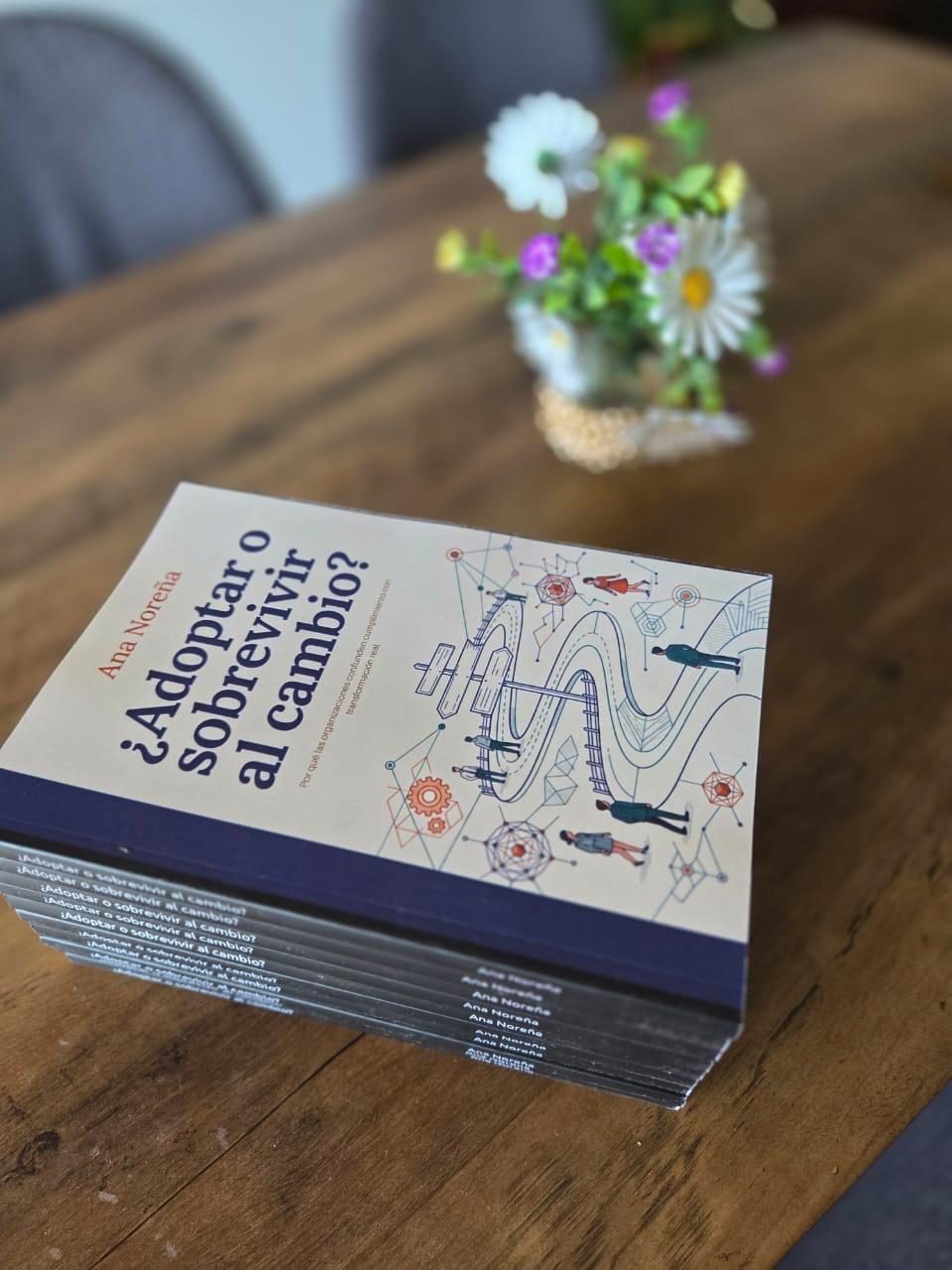
How to find those few, how to read what is holding the old habit in place and how to build the whole system around them is what I develop in my book, Adopt or Survive Change: Why Organizations Confuse Compliance with Real Transformation, because at the end of the day change isn’t communicated, it’s designed.
Sources
- Stanley Milgram, “Behavioral Study of Obedience,” Journal of Abnormal and Social Psychology, 67(4), 1963, pp. 371–378, doi.org/10.1037/h0040525 ↩
- Noah J. Goldstein, Robert B. Cialdini and Vladas Griskevicius, “A Room with a Viewpoint: Using Social Norms to Motivate Environmental Conservation in Hotels,” Journal of Consumer Research, 35(3), 2008, pp. 472–482, doi.org/10.1086/586910 ↩
- BJ Fogg, “A Behavior Model for Persuasive Design,” Proceedings of the 4th International Conference on Persuasive Technology (Persuasive ’09), 2009, doi.org/10.1145/1541948.1541999. See also behaviormodel.org ↩
Did you find this article useful?
Thank you! Your answer helps me choose the next topics.
Does your change plan have microbehaviors or wishes?
It’s the first thing I look at in the Behavioral Adoption Diagnostic: which concrete behaviors your transformation needs, which ones are competing with an old habit, and where it makes sense to start.