For years, the first step in changing an organization was to create urgency. Today, most companies don’t need anyone to create it for them: they live in it every day. The question is no longer how to generate that push, but what that constant pressure does to people’s capacity to adopt something new.
Just another Monday
On just another Monday, at just another company, an operations team receives three announcements. The first one announces the migration to the new ERP. The second invites everyone to activate their generative AI licenses “as soon as possible.” The third is a reminder that the new hybrid work model takes effect next month. All three have a different sponsor, a different change plan, and the same underlying message: this is a priority.
None of the three is wrong. Each one, on its own, makes sense. The problem is that people don’t experience them on their own. They experience them together, on the same calendar, with the same attention span, and with the same capacity to learn something new while still getting the day’s work done.
And that’s where a question that has bothered me for a while comes in: if the classic first step of change is to create a sense of urgency, what happens when urgency is already the normal state?
What Kotter got right
It’s fair to start here, because when John Kotter made a sense of urgency the first step of Leading Change (1996)[1], he was naming a real problem: many transformations failed because the organization was too comfortable to move. Without a shared reason to change, no plan ever got off the ground.
And Kotter didn’t stand still. In A Sense of Urgency (2008)[2], he distinguished true urgency from false urgency, the kind that looks like lots of activity, lots of meetings, and lots of anxiety, but little real progress. In Accelerate (2014)[3], he acknowledged that the world was moving too fast for the traditional hierarchy and proposed a dual operating system, with an agile network running alongside the usual structure.
In other words, Kotter himself saw that the context was changing. So my point is not that he’s wrong, but that most organizations still apply step 1 as if it were 1996.
The assumption that changed
The classic models, Kotter and ADKAR alike, were built on an implicit assumption: one change at a time, with a before, a during, and an after. That assumption no longer describes how most companies work.
The data shows this quite bluntly. According to Gartner, in 2022 the average employee experienced 10 planned enterprise changes, up from 2 in 2016. Over the same period, employees’ willingness to support change dropped from 74% to 43%[4].
Five times more change and almost half the willingness. So we can infer that the problem is not that we haven’t communicated with enough urgency, but that it is a problem of exhausted capacity.
When each initiative runs its own step 1 separately, the organization ends up with ten urgencies competing for the same attention, and when everything is urgent, nothing is.
What chronic urgency does to behavior
Urgency works like a stimulus: it mobilizes people when it’s exceptional. However, when it becomes permanent, it stops mobilizing and starts producing other effects, which are rarely read correctly from inside the project.
Saturation: Every change demands attention, practice, and a tolerance for losing fluency for a while. If ten arrive at once, people don’t adopt ten new things: they prioritize whatever gets them through the week and fall back on the familiar for everything else.
Learned waiting: When a company launches many transformations that never consolidate, people learn to wait. They wait to see whether this time it’s for real, whether the sponsor keeps the message going, whether the old tool actually goes away. That waiting is often called resistance, but many times it’s accumulated experience.
Limbo: The new thing gets launched, but the old one is never switched off. The new system exists, but Excel is still accepted. The formal channel is live, but questions get solved over chat. That coexistence drains energy every day and keeps building up what I call, in my book, behavioral debt.
The paradox is that the usual response to these symptoms is more urgency: another email, another reminder, another follow-up meeting. In other words, more of the same thing that created the problem.
From a sense of urgency to a sense of capacity
My proposal is not to eliminate urgency. It is to stop treating it as the default starting point and to begin with a different question: how much change can this team absorb, right now, without burning out?
That means shifting the conversation from “why change” to “what can be sustained.” In practice, before launching an initiative, I would ask these questions:
- What other changes are landing on the same people? Not on the organization in general, on this team, this quarter.
- How many new behaviors are we asking for, in total? Not how many projects, how many behaviors. A small release for IT can be huge for the person who has to change the way they make decisions.
- Which previous change hasn’t consolidated yet? If the old way is still alive, the new one lands on top of debt.
- What are we going to stop asking for? Prioritizing is not just deciding what gets done, it’s also deciding what we don’t ask people to do yet.
- Who protects people’s capacity to absorb change? If every sponsor defends their change as critical, nobody looks at the total.
This doesn’t contradict Kotter. In fact, it’s quite close to what he called true urgency: focus on what really matters, instead of anxious activity. The difference is one of scale. It’s no longer enough for each initiative to have its own well-built urgency. Someone has to look at the full portfolio of urgencies from the side of the people who have to adopt them.
Changing fast is not the same as adopting fast
Speed matters, and much more so in today’s context. But an organization can move very fast on the roadmap and very slowly on adoption. When that happens, urgency doesn’t accelerate change: it makes it more expensive.
Kotter taught us that without urgency, nothing moves. Today I believe we also have to learn the opposite: with too much urgency, nothing sticks.
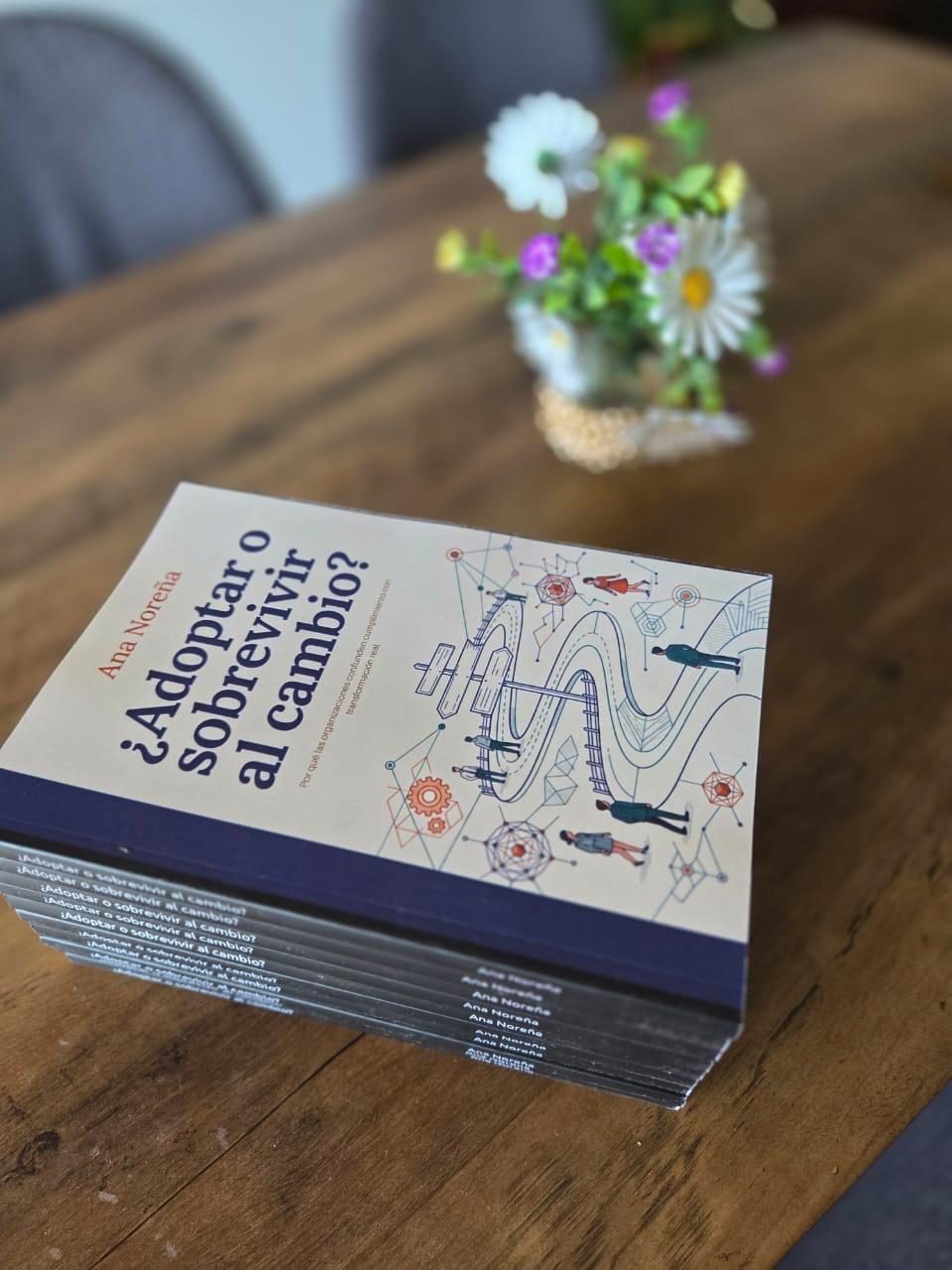
This is one of the topics I explore in Adopt or Survive Change, especially in the chapter on permanent transformation. Because in the end, the advantage won’t belong to the organization that launches the most changes the fastest, but to the one that learns how many it can absorb, in what order, and what it needs to consolidate before adding the next one.
Sources
- John P. Kotter, Leading Change (Harvard Business School Press, 1996). ↩
- John P. Kotter, A Sense of Urgency (Harvard Business Press, 2008). ↩
- John P. Kotter, Accelerate: Building Strategic Agility for a Faster-Moving World (Harvard Business Review Press, 2014). See also “John Kotter's Plan to Accelerate Your Business,” HBS Working Knowledge, library.hbs.edu ↩
- Cian O Morain and Peter Aykens, “Employees Are Losing Patience with Change Initiatives,” Harvard Business Review, May 2023, hbr.org ↩
Did you find this article useful?
Thank you! Your answer helps me choose the next topics.
How much change can your organization absorb today?
It’s one of the questions I work on in the Behavioral Adoption Diagnostic: looking at the real load landing on each team, which changes still haven’t consolidated, and what should be sequenced before adding the next initiative.